.png)


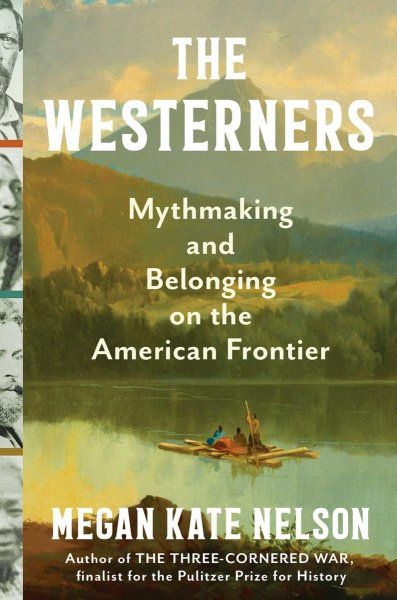
"The Westerners" | Reviewed by Bill Schwab
- cstucky2

- Jun 16
- 3 min read
The West has drawn the attention of Americans since almost the nation's founding. The Lone Ranger, Hopalong Cassidy, and Roy Rogers introduced me to the American West. In elementary school, Daniel Boone, Davy Crockett, and Kit Carson furthered my education of this vast territory. I watched the West unfold through films starring John Wayne, Audie Murphy, Clint Eastwood, and other tough cowboys. My understanding of the West has expanded considerably as an adult, but nothing has widened my perspective of the West as much as Megan Kate Nelson's latest book.
In President Thomas Jefferson's first inaugural address, on March 4, 1861, Jefferson spoke of the US as "a rising nation, spread over a wide and fruitful land" and "advancing rapidly to distances beyond the reach of mortal eye." By 1803, the US had acquired the Louisiana Territory, fulfilling, in part, President Jefferson's projection.
Historian Nelson cites Jefferson's vision of western expansion as one of the first verbalizations of the "frontier myth," a vision that remains prominent in popular culture. Today, there remains a film category called Westerns, and a popular Country-and-Western music genre that produces songs that regularly top The Billboard Hot Country Songs chart.
To counterbalance the long-held "frontier myth,” historian Nelson tells two brilliantly detailed and interwoven stories about the American West. In the first story, she explores the lives of Indigenous peoples, Black Americans, Mexican Americans, and Canadian and Asian immigrants living in the American West. In this recounting of history, she debunks the narrow, common view of the West, especially the portrayal of it as the home of white men alone.
The second story focuses on the aggressive efforts by Americans to erase the many cultures of Westerners from history by lionizing individualism and conquest, and glorifying white settlers traveling West in search of property and wealth, and in the process, supplanting the people living there. Nelson maintains that western expansion was a complex, communal, and often bitter process, rather than a romanticized conquest.
Her compelling narrative traces the journeys of seven extraordinary people whose lives capture the true history of the West. Nelson begins with Sacajawea, who served as the interpreter and guide for the Lewis and Clark exploration of the Louisiana territory. Sacajawea knew the landscape and had foraging skills to supplement the explorers' limited food supply. She could locate and collect scientific specimens that Jefferson had asked Lewis and Clark to gather.
María Gertrudis Barceló was a successful businesswoman who operated a gambling saloon that amassed her a fortune. María was a Spanish subject until 1821, when Mexico won independence from Spain. Nelson notes that Spanish women had more rights than American women: they could legally own property and run businesses.
Another courageous westerner was Jim Beckwourth, the son of an enslaved Black woman and her white enslaver. After Beckwourth was set free by his father, he set out for the West, where he worked as a fur trapper, gold miner, farmer, rancher, and courier for the US Army during the Mexican-American War. Beckwourth also spent several years living as an adopted member of the Apsáalooke band in the Rocky Mountains. As a biracial man, "he often chose to pass as Indigenous or white as the circumstances demanded in the dynamic communities of the American West."
The remaining characters she describes are equally compelling. They include Little Wolf, a Northern Cheyenne chief who for years resisted the US government's mandate to relocate his people to a reservation, and Polly Bemis, a Chinese woman who was smuggled to Idaho and made a life despite federal legislation targeting Chinese immigrants.
"Before the Civil War, the West was chaotic and unstable, a landscape of transformation," Nelson observes. "Because of this, men and women from a variety of racial and ethnic communities were able to claim spaces for themselves there."
In this meticulously researched work, Megan Kate Nelson shatters the "frontier myth" and brings to life a true picture of the wide range of people who lived on the American frontier. She offers a new, persuasive, and fresh understanding of the West. Scholars and general audiences will find this book deeply researched, informative, and engaging.
I anticipate an award for this outstanding history.
About the author: Megan Kate Nelson is the author of several books, including "The Three-Cornered War: The Union, the Confederacy, and Native Peoples in the Fight for the West," which was a 2021 Pulitzer Prize finalist in history. She has written about US Western history, the Civil War, and American culture for The New York Times, The Washington Post, The Atlantic, and Smithsonian Magazine. Nelson taught US history and American studies at Texas Tech University, Cal State Fullerton, Harvard, and Brown before leaving academia to write full-time in 2014.