.png)


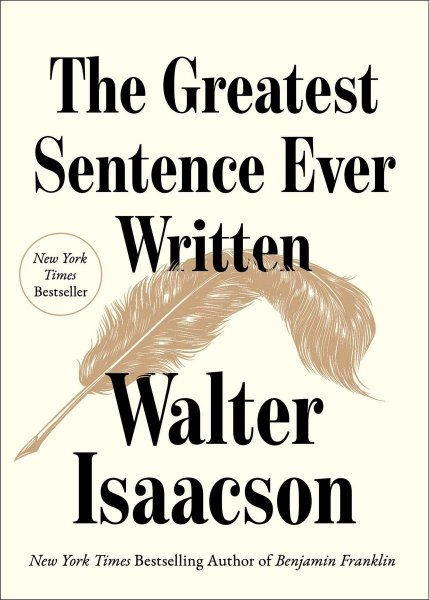
"The Greatest Sentence Ever Written" | Reviewed by Bill Schwab

The second sentence of the Declaration of Independence declares, “We hold these truths to be self-evident, that all men are created equal, that they are endowed by their Creator with certain unalienable Rights, that among these are Life, Liberty, and the pursuit of Happiness.” On the 250th anniversary of its adoption, Walter Isaacson has written an 80-page book that examines and appreciates each word and vision of the Declaration. Isaacson maintains that the second sentence is the “greatest sentence ever crafted by human hand”.
Thomas Jefferson, Benjamin Franklin, and John Adams were members of the “five-person drafting committee.” Jefferson wrote the first draft, Franklin made the edits, and Adams fiercely defended the document on the floor of the Continental Congress until its adoption on July 4, 1776.
Written during the Enlightenment, the second sentence was influenced by numerous earlier documents. John Locke’s social contract theory was a major inspiration. His theory protects the natural rights of individuals, such as “life, liberty, and the pursuit of happiness.”
The social contract theory holds that an effective society provides a common pool of resources in addition to the private property people own. The famous sentence was also prompted by Benjamin Franklin’s experience living with the Scottish philosopher David Hume for a month in the early 1770s, during which they were “discussing ideas of natural rights”. The ethics and values of Puritanism also contributed to the historical document, among other sources.
In his critique of the Declaration, the professor correctly points out the contradictions in the Declaration of Independence, which proclaims equality while intentionally excluding women, Native Americans, and tolerating slavery. Thomas Jefferson enslaved hundreds of people, and all but 15 of the document’s 56 signatories owned enslaved people. The author points out these inconsistencies yet defends the second sentence because it names the new nation’s “aspirations.”
Isaacson wages a strong defense of what ought to be common goals in a democracy: economic fairness, “moral compassion,” and the willingness to compromise.
In the final three chapters of the brief volume, Isaacson shifts from an appreciation of the second sentence to what he sees as the United States’ current problems. He maintains that what the US has lost and needs to recover is the “commons,” or the social contract advanced by Locke. Isaacson views our current political crisis as the consequence of self-segregation, as evidenced in gated communities, private schools, VIP sections, and biased news organizations. He calls for the US to get back to its “commons” roots.
I appreciated the succinct history of the Declaration of Independence and the author’s analysis of what he calls the most famous passage in all of the United States’ foremost documents. His essay points both to the strength of the United States and its enduring aspirations.
About the author: Isaacson is the author of biographies of Benjamin Franklin, Henry Kissinger, Albert Einstein, and five others. He has been the editor of Time, the CEO of CNN, and the CEO of the Aspen Institute. In 2023, he was awarded the National Humanities Medal. Isaacson is currently the Leonard Lauder Professor of American History and Values at Tulane University.