.png)


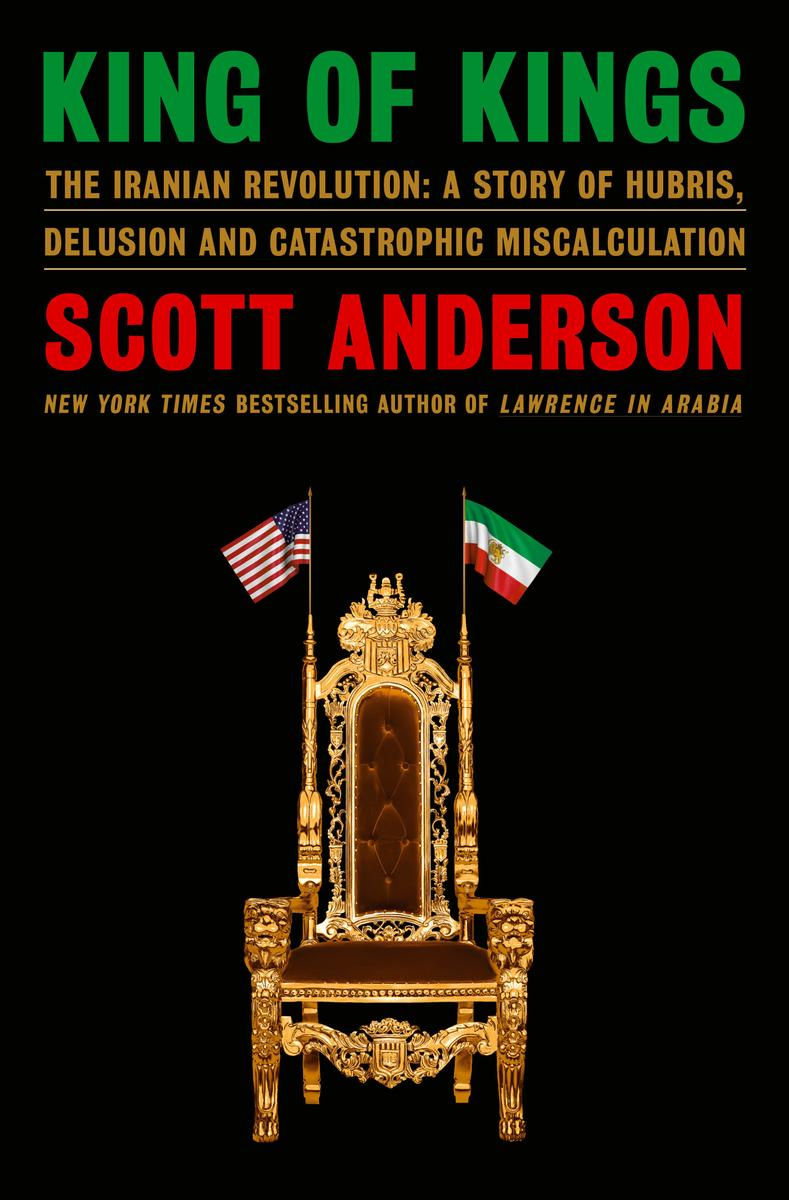
"King of Kings: “The Iranian Revolution: A Story of Hubris, Delusion and Catastrophic Miscalculation" | Reviewed by Bill Schwab

In August 1977, the Central Intelligence Agency published a secret document assessing the political situation in Iran. The report predicted that Shah Mohammed Reza Pahlavi, "will be an active participant in Iranian life well into the 1980s." This appraisal signaled that the U.S.-allied Shah of Iran would be King of Kings, Light of the Aryans, and Shadow of God on Earth, for the foreseeable future. Shockingly, 20 months later, on June 16, 1979, the Shah and his family were airlifted to Egypt to escape an Islamist revolution led by the backward-looking Ayatollah Ruhollah Khomeini.
Scott Anderson examines the serious miscalculation of the CIA on page 1 of his deeply researched history of the final years of the Pahlavi dynasty, and the early days of the Khomeini Islamist theocracy. Anderson presents a gripping account of the Iranian crisis that springs to life with its attention to detail and its stirring narrative. He chronicles the decisions and actions of the medieval-minded supreme religious leader as he rejects the U.S. This condemnation remains as malicious toward the United States today as it was at the time of the coup.
The account tries to answer many questions about the overthrow of the Pahlavi dynasty: Why did the Shah fall? Why did the CIA miscalculate this revolution? Why did the collapse happen so quickly? Why did the Shah fail to defend his sovereignty?
Iran's geopolitical location adjoining the Soviet Union, its large oil reserves, and its role as a stable, anti-communist regime supported U.S. foreign policy goals in the region.
Why did the hegemonic United States not see the danger to one of its most important allies in the Middle East until it was too late? To the latter question, Anderson maintains the Shah was "so profoundly important to the United States that it couldn't perceive of life without him—and so it did not." Instead, the U.S. "happily bought into his fictions, both of himself and of his nation."
From the outside, Iran appeared to be stable and thriving. Per capita income increased 20 times during the Shah's tenure. The literacy rate increased fivefold, and life expectancy increased from 27 to 56. Women received new rights, and 500,000 Iranians graduated from college. Only 100 dissidents were killed by the secret service during the Shah's decade in power. By contrast, "as many as 8000 Iranians were executed in the first four years of Islamic rule, with as many as 5000 more killed in a single week" in July 1988 to purge" leftists."
The author depicts streets teeming with protesters, behind-the-scenes palace scheming, and the politics of U.S interests. Anderson deftly captures the deviousness and ineptness that blinded Iran and the United States to the conspiracy. Through relying on interviews with three key people who lived throughout the revolution, he records the series of maladroit decisions that led to the inevitable fall of the monarchy and the rise of the rule by priests.
Critically and systematically reported with cynical drollness, "King of Kings" is a page-turning account of the Iranian revolution, one of the most significant events of the 20th century that continues to shape the Middle East today. The book is highly readable and probing. I found Anderson's chronicle to be an ideal lesson for U.S. citizens today as our federal government undergoes perilous upheaval and momentous change.
About the author: Anderson has written two novels and five works of nonfiction, including "Lawrence in Arabia," a finalist for the National Book Critics Circle Award and a New York Times notable book. He is a contributing writer for the New York Times Magazine, which, on August 20, 2016, devoted an entire issue to Anderson's reporting about the Middle East, which was published in book form as "Fractured Lands: How the Arab World Came Apart."