.png)


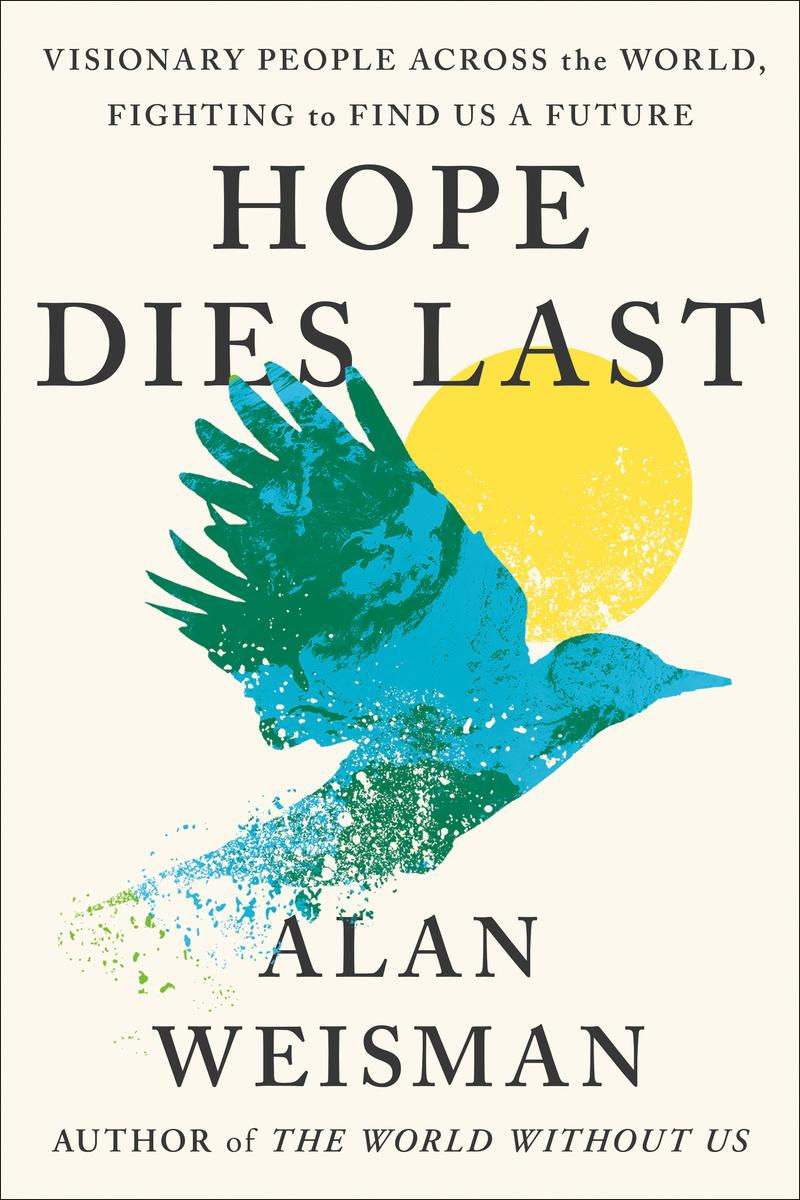
"Hope Dies Last"| Reviewed by Bill Schwab
- cstucky2

- Aug 16, 2025
- 2 min read
"Hope Dies Last" is a thoroughgoing examination of life on a rapidly warming planet. In this profoundly human and deeply moving narrative, Alan Weisman investigates the precarious predicament of Earth due to global warming. He then responds with the exhilarating optimism offered by people striving to mitigate the atrocities inflicted on our planet by past and present human beings.
To compose this book, the environmental journalist traveled the globe to witness firsthand the areas of devastation caused by climate change and to meet with visionaries addressing the climate crisis. The author profiles individuals determined to find ways to mitigate the planet's heating, thereby improving humanity's chances for a better future. Weisman investigates methods to prevent the extinction of species crucial to human survival and explores strategies to increase food production, thereby reducing the risk of catastrophic famines and massive refugee migrations.
Of his journeys he writes,
"Among the most memorable [experiences] were traveling with a scientist through the Sundarbans, the world's largest mangrove forest and biggest tiger habitat, on the Bangladesh-India border; being held in solitary confinement in a northern Minnesota county jail after being arrested while witnessing protesters chain themselves to pumps, while Ojibwe women lay in front of an oil pipeline being rammed through their wild rice harvesting region; Dutch engineers who showed me the ingenious ways their country avoids drowning, but who wonder how long that can last, even as the world turns to them to stop rising waters everywhere; finding a revolutionary energy solution in a Rohingya refugee camp, and following the Mesoamerican Reef, the world's second longest, from Honduras to the Yucatan, where coastal engineers took me to the Chicxulub: epicenter of the asteroid strike that ended the Age of Reptiles giving us mammals our chance—unless, of course, we blow it."
Weisman visited engineers, conservationists, economists, architects, and artists—from the Marshall Islands to the Korean DMZ and US coastlines —as they summoned up imaginative responses to the heat, hunger, and rising tides that face the human species. He found that all these big thinkers and innovators refuse to accept the extinction of the species and look forward to a decidedly different future.
His meticulous narrative presents the reader with a frank look at Earth's perilous dilemma, as well as the extraordinary human ability to hold on to hope in these challenging times. The author maintains that hope is an action verb — "we don't wait for miracles, but set out to make them."
For those with climate anxiety, this is a reassuring book. The visionaries the author introduces are inspiring, imaginative, and ingenious. Reading this book lifted my spirits and made me deeply grateful for the amazingly resourceful and generous people "fighting to find us a future."
About the author: Alan Weisman has reported from all seven continents and more than sixty countries. His book, "The World Without Us," the winner of China's Wenjin Book Prize, has been translated into thirty-four languages. His work has appeared in The Atlantic, Mother Jones, Harper's, and many other periodicals. A co-founder of the journalism collective Homelands Productions, he was laureate professor of international journalism at the University of Arizona.